How to Allocate Your Money Across Stocks, Gold, Crypto & Bonds
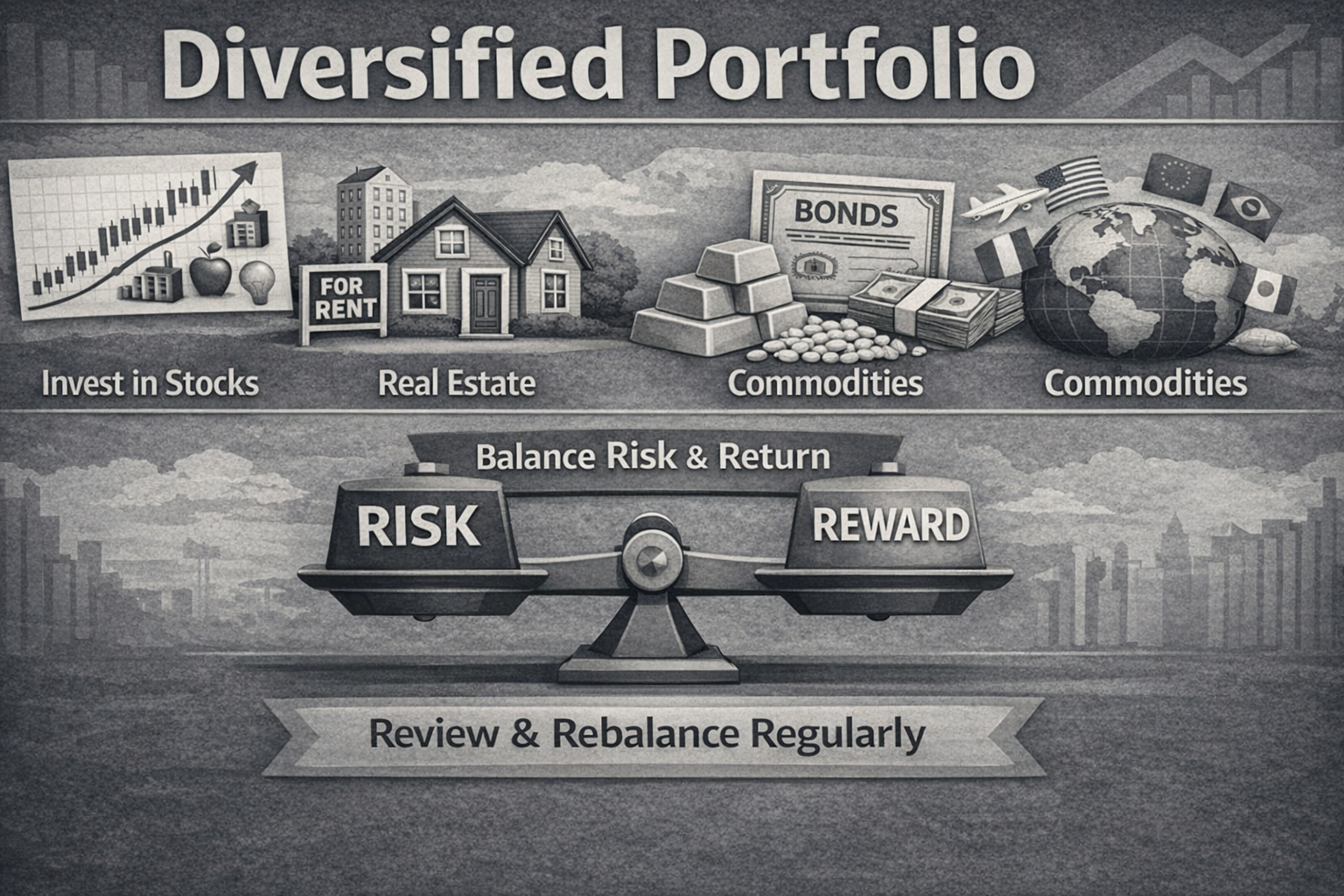
Many investors put all their money into a single asset—whether it's stocks, gold, or even Bitcoin—simply because they trust it the most. While that approach can work in some cases, it also increases risk significantly.
A more balanced approach is to spread your investments across multiple asset classes. This strategy—often called a diversified portfolio—helps reduce risk and makes long-term investing less stressful.
In this guide, you’ll learn how to allocate your money across stocks, gold, crypto, and bonds using a simple, practical example.
One of the typical approaches (I don't want to say mistake) is that people usually invest in one asset because they trust it the most or they don't feel open for other assets, especially for crypto world or some other asset type or they just don't want to spend time investigating other options. I met those kind of people in many situations. For example I know people who only invest in gold or only invest in ETFs, even those who comitted only to bitcoin as one of the most if not the most powerful asset in the last 15 years.
Guess what, I don't want to say that these people are making mistake but I like diversification - which means investing in multiple assets at once. In this way, I can talk with all of them and exchange our experiences, but what is more important I don't depend whether I chose good or wrong asset at that moment, month or year. It is somehow less stressful for me to think about it.
What Does It Mean to Spread Your Investments?
Spreading your investments across different asset classes—often called diversification—means not putting all your money into a single investment. The goal is simple: don’t put all your eggs in one basket. By diversifying, you reduce the impact of a single asset performing poorly while still allowing for growth from other investments.
Common Asset Classes
- Stocks: Shares of companies, often tracked through broad indexes like the S&P 500 or Nasdaq. Stocks generally offer higher returns but come with more volatility. I personally prefer to have these ETFs in my portfolio.
- Cryptocurrencies: Digital assets like Bitcoin or Ethereum. These can be highly volatile but you can get high gain from them. If you are someone who looks into your portfolio every day to check for price changes and you get too nervous about it, I suggest being careful. I have faced big money swings with Bitcoin. Taking this into consideration, my portfolio has a small amount in cryptocurrency, and I invest a small amount regularly.
- Precious Metals: Assets such as gold or silver. Metals often act as a hedge against inflation and market instability. While I am writing this article in December 2025, gold has performed really well this year, with more than 40% growth up to the current point.
- Bonds or Cash Equivalents: Lower-risk investments that provide stability and steady returns.
Why Spreading Your Investments Reduces Risk
Imagine you invested all your money in a single stock, and it drops by 50% in a year. Your entire portfolio loses half its value. Now imagine that same money spread across stocks, bonds, gold and crypto. Even if one asset drops, the others may rise or remain stable, reducing the overall impact on your investments.
Diversification also helps you achieve more consistent returns over time, making it easier to reach your financial goals without taking excessive risk.
How to Allocate Your Money Across Different Assets
1. Define Your Investment Goals
Before choosing assets, clarify your goals:
- Investment horizon: Are you investing for retirement in 20 years, or a short-term goal in 3–5 years?
- Risk tolerance: How much fluctuation can you handle? Can you sleep at night if your portfolio drops 20%?
- Financial target: How much do you want your portfolio to grow?
Your goals determine the right mix of assets.
2. Choose How to Split Your Investments
Select a mix of assets that balances risk and potential return. A simple example allocation could look like this:
- 50% stocks (broad index funds like S&P 500)
- 25% gold or precious metals
- 10% crypto or other cryptocurrencies
- 15% cash or bonds
This type of allocation helps you reduce risk because different assets behave differently. For example, stocks may grow steadily over time, while gold can act as a hedge during uncertainty, and crypto can provide high growth potential but with higher volatility.
You can adjust these percentages based on your comfort level. Younger investors may lean more toward stocks and crypto for higher growth, while those closer to retirement may prefer safer bonds and metals.
3. Use a Portfolio Calculator
Manually calculating potential growth and comparing different asset allocations can be complex. A Portfolio Calculator can simplify this by letting you:
- Enter multiple assets and their allocations
- Simulate growth over months or years
- Compare different portfolio scenarios
For example, you can see how a mix of Bitcoin, S&P 500, and gold might grow over 10 years. Our Portfolio Calculator allows you to experiment with different strategies and see potential results instantly.
4. Start Small and Grow Gradually
You don’t need to invest large sums right away. Even small contributions each month can grow significantly over time thanks to compound growth. For example:
- Investing €100 per month for 10 years at an average 7% annual return could grow to over €17,000.
- Adding a volatile asset like Bitcoin may increase potential gains — but also increases risk.
Small, consistent investments are often safer and less stressful than trying to time the market with a lump sum.
5. Monitor and Rebalance Your Portfolio
Diversification isn’t a one-time task. Over time, some assets will grow faster than others, altering your original allocation. Rebalancing means adjusting your portfolio to bring allocations back in line with your strategy.
For example, if Bitcoin grows faster than other assets and now makes up 40% of your portfolio instead of 20%, you might sell some Bitcoin and invest in other assets to maintain balance. Regular monitoring ensures your risk stays consistent.
Tips for Spreading Your Investments Effectively
- Include assets with low correlation: Don’t invest only in similar assets; mix growth stocks, crypto, metals, and bonds. I like the fact that when the S&P 500 or Bitcoin drops, I have gold, which usually complements ETFs and crypto.
- Rebalance periodically: Adjust allocations to maintain your target risk level.
- Stay consistent: Monthly contributions matter more than perfect timing.
- Educate yourself: Understand how each asset behaves under different market conditions.
- Track performance visually: Charts and graphs help you see growth trends and adjust as needed.
Common Mistakes to Avoid
- Investing only in “hot” assets without balance
- Ignoring bonds or safer investments
- Failing to rebalance over time
- Letting emotions drive decisions instead of strategy
Remember, diversification is about reducing risk, not eliminating it completely. Some losses are inevitable, but a well-planned portfolio can help you achieve steady long-term growth.
What Is the Best Way to Split Investments?
There is no single perfect allocation that works for everyone. The best way to split your investments depends on your goals, time horizon, and risk tolerance.
For long-term investors, a higher allocation to stocks may make sense. If you prefer stability, adding more bonds or gold can reduce volatility. Small exposure to crypto can increase potential returns but should be carefully managed.
The key is to find a balance that allows you to stay consistent—even during market downturns.
Conclusion
Learning how to allocate your money across stocks, gold, crypto, and bonds can significantly improve your long-term results. Instead of relying on a single asset, spreading your investments helps reduce risk and creates more stable growth over time.
Tools like our Portfolio Calculator make it easy to plan, track, and optimize your portfolio over time.
Start today and experiment with different ways to split your investments to build a strategy that works for you.
Related:
- Why Not Just Invest in the S&P 500?
- How Many Assets Should a Portfolio Have? Practical Guide for Investors
- How a 1% Change in Annual Growth Rate Can Transform Your Investment Portfolio | Portfolio Calculator
- Aggressive vs Conservative Portfolios: Risk, Returns, ETF Examples & Real Market Drops
- How Often Should You Rebalance a Portfolio? (5–10% Rule Explained)