Why Not Just Invest in the S&P 500?
Why the S&P 500 Looks Unbeatable
Investing only in the S&P 500 seems like a good idea because of these advantages:
- Strong long-term returns
- Exposure to the world's strongest companies: U.S.-based companies generate 30–60% of revenue globally
- Survival mechanism: Strong and growing companies replace poor performers
- Simplicity: Minimal effort and low costs
- Backed by economic and political power: The U.S. is the world's largest economy
- High liquidity: Many people invest in this ETF, making it easy to buy and sell
But strong historical performance does not eliminate risk.
Historical Periods When It Underperformed
- The Lost Decade (2000–2009) – Impacted by the dot-com bubble (2000–2002) and global financial crisis (2007–2009). Average return before inflation was ~–0.9% per year. Cumulative real return in the U.S. was around 25–30%.
- Flat Market with High Inflation (1966–1982) – Nominal returns were fine, but inflation averaged 6–7% per year. In 1966 S&P 500 traded around 94 and by 1982 around 100. Inflation silently destroyed purchasing power.
- The Great Depression Recovery (1929–1954) – Took 25 years to regain previous peak in nominal terms; real-term recovery took even longer.
Some Big Drawdowns
- 1973–1974: ~–48%
- 2000–2002: ~–49%
- 2008: ~–57%
- 2020: ~–34%
Concentration Risk (Top 10 Stocks Issue)
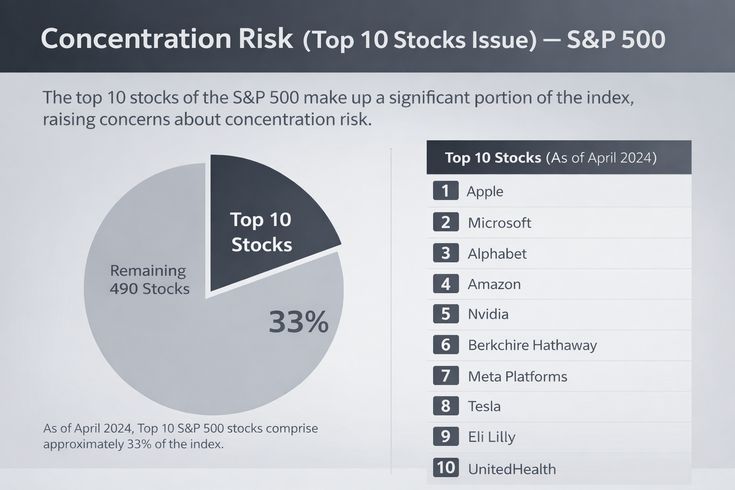
S&P 500 contains 500 companies but is market-cap weighted, so largest companies have much bigger impact than the rest. In recent years, the top 10 stocks weighed around 30–35%, making the S&P 500 less diversified than it appears.
If the top 10 stocks fall by 20–30%, the index declines significantly even if the remaining 490 stocks are slightly positive. Smaller companies have limited ability to compensate for losses from the largest holdings.
Example weight breakdown:
- Top 10 stocks: ~35%
- Remaining 490 stocks: ~65%
- Average weight per remaining stock: 65 ÷ 490 ≈ 0.132% per stock
Valuation Risk and Future Returns
Valuation risk is the risk of buying the market when prices are high relative to historical averages. It can indicate long-term returns, but cannot predict next year.
High valuation increases the likelihood of:
- Lower long-term returns
- Higher volatility
- Longer recovery periods after downturns
Research shows:
- High starting valuations → lower future returns
- Low starting valuations → higher future returns
Valuation risk doesn’t mean avoiding the S&P 500 entirely, but it emphasizes the importance of realistic expectations and diversification.
Currency & Country Risk (Especially for Non-U.S. Investors)
For investors outside the U.S., S&P 500 investments carry currency and country risks.
Currency Risk
The S&P 500 is calculated in U.S. dollars. A 10% rise is in USD, not euros, pounds, etc., so local currency fluctuations affect real returns.
Example:
- S&P 500 return: +10%
- USD weakens against your local currency by 9%
- Real return: ~1%
Currency movements can enhance, reduce, or completely cancel out gains. These effects can persist for many years.
How Investors Manage This Risk
- Use currency-hedged S&P 500 ETFs
- Diversify into non-U.S. equity markets
- Balance USD exposure with local-currency assets
What Diversification Actually Solves
Diversification is often described as the golden rule of investing, but many investors misunderstand its purpose. It does not guarantee higher returns or protect completely against losses. Instead, diversification reduces avoidable risk, helping portfolios perform across different market conditions.
- Reduces Single-Asset or Sector Failure Risk
Putting all money into one stock, sector, or country exposes investors to catastrophic losses if that asset collapses.
Example: An investor invested solely in technology stocks in 2000 suffered huge losses during the dot-com crash. A diversified portfolio including technology, healthcare, consumer goods, and bonds avoided permanent damage.
Solution: Diversification limits the impact of a single asset or sector failure on the overall portfolio.
- Smooths Returns Across Asset Classes
Different assets behave differently under various economic conditions.
- Stocks → tend to perform well during economic growth
- Bonds → provide stability during recessions
- Real assets (real estate, commodities) → often hedge against inflation
Example: A portfolio holding stocks, bonds, and real assets is less volatile than a stock-only portfolio, even if long-term returns are similar.
Solution: Reduces overall volatility and drawdowns, making it easier to stay invested during market stress.
- Reduces Country or Regional Risk
No single country performs well all the time. Investing globally reduces dependence on one economy.
Example: From 2000 to 2010, U.S. stocks were flat, but emerging markets grew strongly. Investors diversified internationally avoided a “lost decade.”
Solution: Mitigates long-term underperformance due to one country’s economic cycle.
- Reduces Currency Risk
For non-domestic investors, investing in assets denominated in a single currency introduces exchange rate risk.
Example: A European investor earns 8% from U.S. stocks, but the USD falls 7% against the euro, leaving a real return of only 1%. A diversified portfolio with multiple currencies reduces this risk.
Solution: Minimizes the impact of unfavorable currency movements on long-term returns.
- Protects Against Overvaluation
Buying only highly valued assets increases the risk of poor long-term performance.
Example: In the late 1990s, U.S. stocks were expensive, while international stocks and bonds offered better value. Diversified investors benefited when valuations normalized.
Solution: Reduces exposure to overvalued markets, improving long-term risk-adjusted returns.
In short, diversification across asset classes, regions, and currencies helps manage risks that a single market or index—like the S&P 500—cannot fully eliminate. It’s not about chasing higher returns, but about protecting the portfolio and increasing the odds of sustainable, long-term growth.
When Investing Only in the S&P 500 Might Still Make Sense
Despite its risks, investing solely in the S&P 500 can still be appropriate in certain situations—if the investor understands and accepts the trade-offs.
- Long-Term Horizon: Investors with 20–30+ year time horizons and high risk tolerance can benefit from the S&P 500’s historical growth. U.S. equities have historically recovered from major downturns, but this requires staying invested through large drawdowns and extended periods of underperformance.
- Simplicity for New or Small-Scale Investors: Beginners or those with limited capital may prioritize simplicity over complexity. A single low-cost S&P 500 ETF allows consistent contributions, avoids market timing, and minimizes fees.
- U.S.-Based Investors: For those earning, spending, and retiring in U.S. dollars, currency risk is minimal. The S&P 500 aligns naturally with future liabilities.
- Core Holding for Diversified Portfolios: Even for investors with a broader portfolio, the S&P 500 can serve as a growth-focused core allocation, while other assets provide diversification benefits.
The key is awareness: understanding concentration, valuation, and currency risks, and making informed decisions rather than relying blindly on historical performance.
Conclusion: Why Not to Invest Only in the S&P 500
The S&P 500 has earned its reputation as a strong long-term investment, but relying solely on it exposes investors to several risks:
- Concentration Risk: The index is market-cap weighted, so a small number of mega-cap companies have an outsized influence on returns.
- Valuation Risk: Buying the market when prices are high can lead to lower long-term returns and extended recovery periods after downturns.
- Currency & Country Risk: For non-U.S. investors, fluctuations in the dollar or U.S.-specific economic events can dramatically affect returns.
- Limited Diversification: The S&P 500 cannot protect against sector, asset class, or global economic risks.
For most investors, a more diversified approach across asset classes, sectors, and regions increases the likelihood of smoother returns and better risk-adjusted performance over time.
To see how a diversified portfolio might perform compared to investing only in the S&P 500, try this interactive tool: Portfolio Calculator — compare S&P 500, NASDAQ 100, and Gold.
Using real data instead of assumptions can help you build a portfolio aligned with your goals and risk tolerance, and avoid the pitfalls of relying solely on a single market index.