Aggressive vs Conservative Portfolios: Risk, Returns and Real Examples
Choosing between an aggressive and conservative portfolio is one of the most important decisions an investor makes. While aggressive investing offers higher potential returns, it also comes with higher volatility and emotional stress. Conservative portfolios provide stability but typically grow slower over time.
In this text, we will look at the differences between aggressive and conservative investing.
Have you asked yourself what type of portfolio you want, do you want a more aggressive but risky investment or a slower but safer one? If a more aggressive portfolio brings more money, then the question arises why wouldn't everyone invest in something that brings more money?
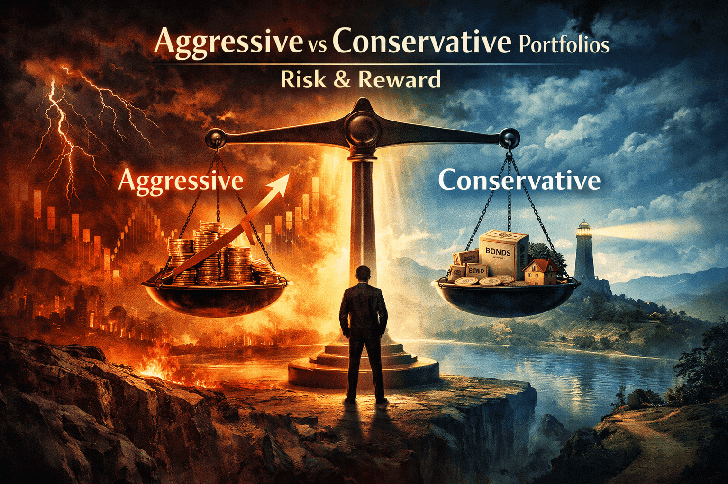
In practice this is not as in theory. When a huge drop occurs that brings a riskier portfolio, that's when you see how tough and persistent you really are. Not everyone can wash it off and endure it. Everything is not as simple as it seems when looking through the numbers.
That is why it is important not to overestimate yourself and insist on higher returns at all costs, because more persistent and lower returns are sometimes much better than panic reactions and giving up in bad periods with riskier investments.
From my own experience, I can say that I experienced a sharp drop in the S&P 500 index, which is considered a fairly stable ETF. The drop was 25%, at that moment not a small amount of money was lost. Regardless of staying the course and not withdrawing investments, in my case it turned out to be a good move for me.
I also experienced a 50% drop in bitcoin and am currently recovering from this sharp drop. Are you ready for these circumstances? Think carefully before you make a decision.
What Is an Aggressive Portfolio?
An aggressive portfolio focuses on higher expected returns and accepts larger short-term losses. These portfolios usually contain mostly stocks or high-growth assets.
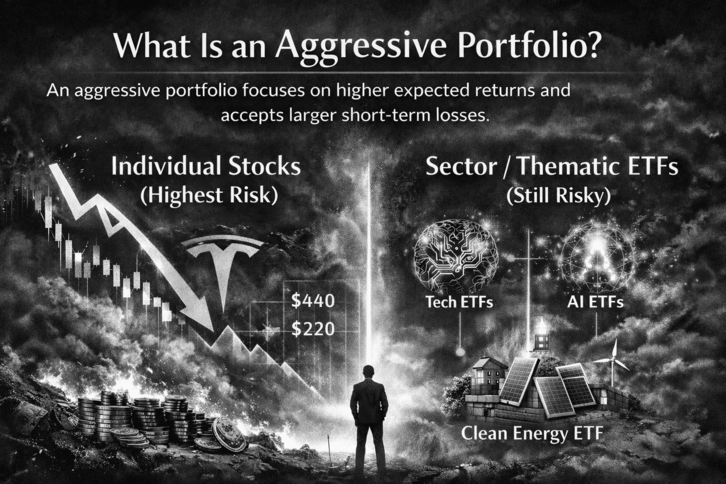
Individual Stocks (Highest Risk)
One example is to invest in the shares of a certain company. I would say that it is probably the riskiest portfolio, that you focus all your funds on the shares of one particular company and that you are completely dependent on the value of that company's shares on the stock market. One bad moment and things can easily change in practice, and you can lose a lot of money if the shares of that company on the stock market fall sharply.
Some examples of this situation are the shares of the company Tesla, which fell at the beginning of 2025 by about 50% or more. The value of these shares halved from $440 to $220. Investors who had invested only in this company lost half of their investments in a period of just a few months due to the growing recession.
If you are starting to invest, think carefully about whether you want to take this risk. The emotional stress is great.
Sector / Thematic ETFs (Still Risky)
Examples:
- Tech ETFs
- AI ETFs
- Clean energy ETF
The good thing about this type of ETF is that there is a certain type of diversification and you don't depend only on one company as in the previous case, but the investments are spread over several companies and the ETF replaces those companies that underperform. However, this diversification is not so great. Investments are still concentrated and the entire sector may underperform during the period.
Some examples where a particular ETF sector has stagnated:
- the tech sector after the Dot-Com Bubble (~ 2000-2010) - many companies survived but it took 10-15 years for the sector to return to its previous peak of 2000
- energy sector (~ 2010 - 2020) - drop in oil prices
- financial sector (~ 2008-2018)
What Is a Conservative Portfolio?
A conservative portfolio focuses on stability, lower volatility, and capital preservation.
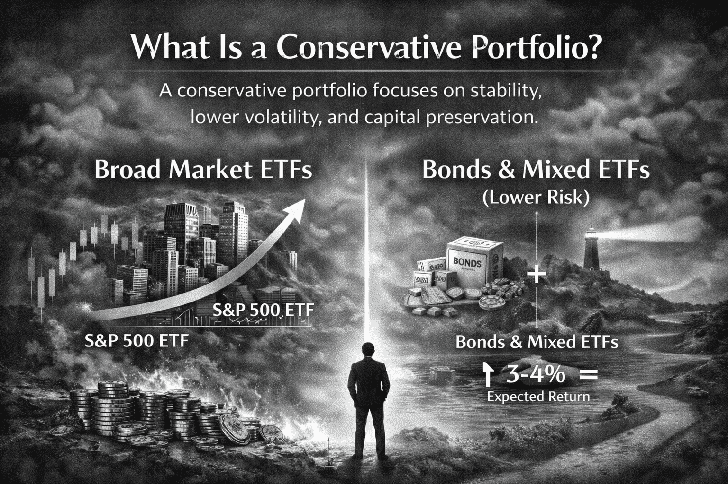
Broad market ETFs
This investment is far less risky than the previous ones, and the largest number of investors choose this option. Examples of such ETFs:
- S&P 500 ETF
- MSCI World ETF
What makes these ETFs popular are:
- hundreds and thousands of companies that are part of these investment funds
- automatic ETF replaces those companies with poor returns
- you don't have to forecast whether a certain company will generate income
- historically they have a positive return in the long run
Bonds & mixed ETFs (lower volatility, lower return)
Bonds are probably the most boring investment. The yields are very low but they are far less volatile than stocks. They represent a conservative way of investing, most often for investors who have come close to the point of withdrawing money and do not want to risk much. Bonds often don't cover inflation so I don't use them in my portfolio, which doesn't mean you shouldn't.
What I would recommend and what happens in most examples
For most people, the portfolio contains more broad ETFs and a smaller percentage of individual stocks.
A common rule:
- 80–90% boring ETFs
- 10–20% “fun / conviction” stocks
Most people don't have the time and energy to research what stocks they should buy, they don't want to read news, reports, etc. and for them this option with broad ETFs is easy, painless and safer.
However, people often want to "be smart", they are interested in some sector, they want to create something of their own, and it is a kind of action game that they find interesting. They use this percentage of the portfolio of 10-20% for that, it turns out to be a good move in the sense that people satisfy their desire and thus save this larger percentage of the portfolio in ETFs, which is more "boring" ie. they don't touch it or sell it.
All this is some kind of psychological game. For most people:
- ETF share = wealth
- stock part = education + entertainment
Examples of aggressive and conservative portfolio:
A conservative example
- 40% MSCI World ETF - this ETF is quite well diversified because it contains about 1300 companies that are the largest or medium developed from 23 developed economies.
- 50% Global Bond ETF - this ETF has an annual historical average return of ~5%. It is a nominal value.
- 10% cash ➡️ expected return: ~5%
Aggressive example
- 90% MSCI World / S&P 500 ETF
- 10% Bond ETF or cash ➡️ expected return: ~8.5%
FAQ
Is an aggressive portfolio better?
No. It depends on your time horizon and emotional tolerance for volatility.
Can conservative portfolios lose money?
Yes. Even bonds and diversified ETFs can decline in certain market environments.
What is a common portfolio rule?
Many investors use 80–90% broad ETFs and 10–20% individual stocks for balance.
Conclusion
There is no best portfolio, but a sustainable portfolio. Therefore, the best portfolio is one that is sustainable in the long run, where the investor will not panic sell his shares in bad periods and where he will keep his investment both in good and bad times. So, in the long term, it is not the most aggressive portfolio that wins, but the one that the investor can withstand.
Everything written in the text is not a guarantee. These are long-term average assumptions based on historical data and in practice things can look different. I'll leave it up to you to decide how you think your money should go.