What Does Investment Gold Look Like in Practice?
When people hear “gold investment,” they often imagine vague ideas: shiny bars in vaults, dramatic price charts, or a hedge against chaos. In reality, investment gold is very concrete. It has specific forms, costs, limitations, and use cases — and it behaves very differently depending on how you hold it.
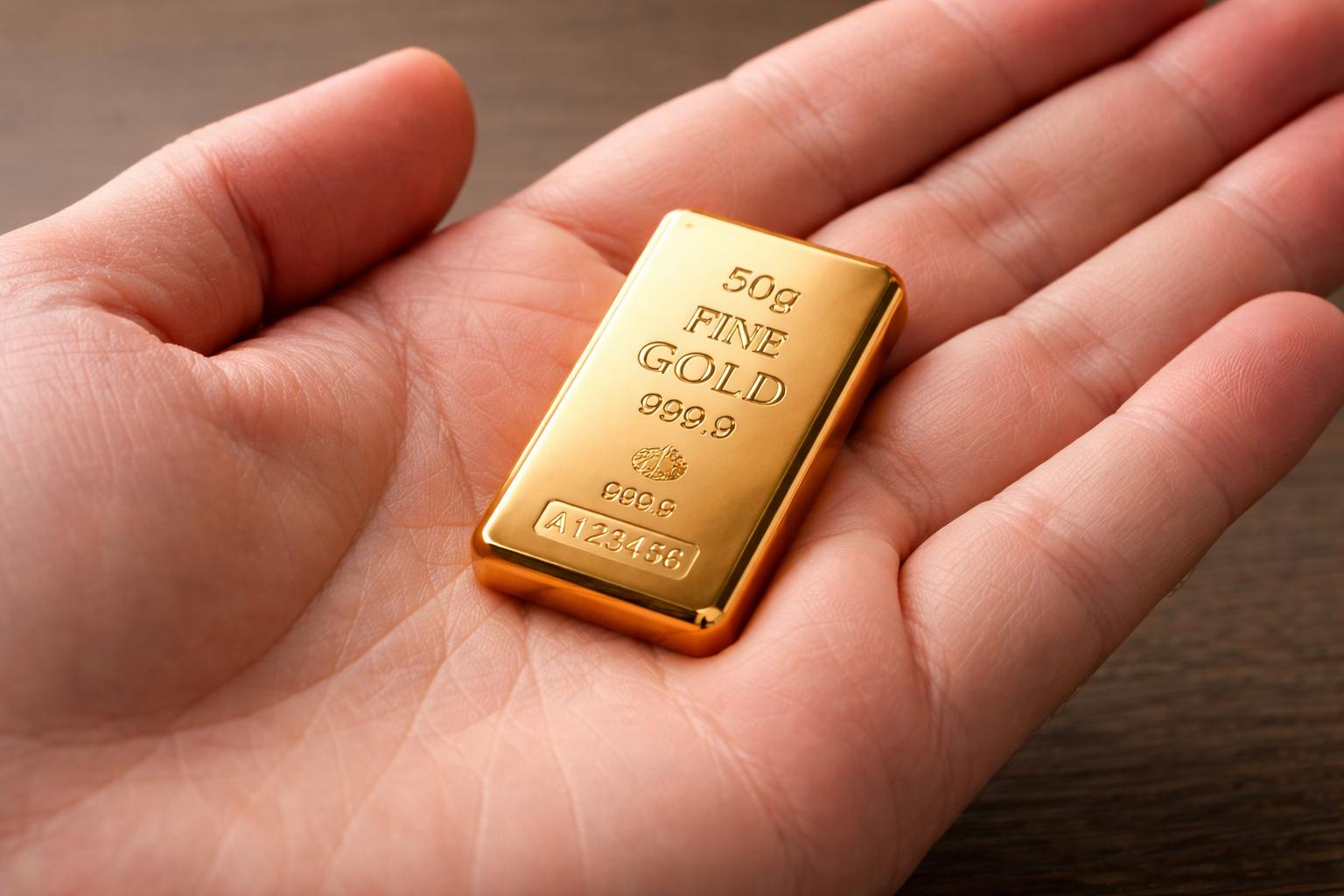
I remember when I was the first time to buy investment gold in local jewelry. I was still insecure about what I would get, so I didn't want to risk being deceived, and I chose very famous local jewelry. Furthermore, I remember when I got my first 50g bar, it looked so small, even in comparison to my palm. I was a little stunned at how much money I gave to get such a small thing, and I asked myself how it's possible that such a small metal chunk could be so valuable and why people pay for it.
Investment Gold Is Not Jewelry (And Not All Gold Qualifies)
One of the most common misconceptions is assuming that anything made of gold is an investment. In practice, investment gold is defined by liquidity, purity, and pricing transparency.
Here’s what investment-grade gold actually looks like:
- Plain gold bars or coins
- Standardized weight and purity
- Minimal design premium
- Easy resale at global market prices
If the gold’s value depends heavily on craftsmanship, brand, or fashion trends, it stops being a pure investment and becomes a consumer good.
Physical Gold Bars: What People Really Buy
Typical Sizes Investors Use
Most private investors do not buy large 1-kilogram bars. Instead, common real-world purchases include:
- 1 oz (31.1 g) bars – most liquid
- 10 g or 20 g bars – lower entry cost
- 50 g bars – balance between premium and size
A typical 1 oz gold bar is:
- Roughly the size of a USB stick
- Plain, stamped with weight and purity (usually 999.9)
- Packaged in a plastic assay card or capsule
Practical Cost Example
Let’s say the gold spot price is $4,400 per ounce.
- Spot price: $4,400
- Dealer premium: $100–$150
- Total paid: approximately $4,500
That premium is not optional. It’s the cost of liquidity, fabrication, and distribution.
Gold Coins: Why Investors Prefer Them
Coins are often more practical than bars, even though they contain the same amount of gold.
Investors often prefer gold coins over bars not because of higher returns, but because of liquidity and simplicity at the point of sale. In real-world transactions, coins are easier to price, verify, and resell.
A one-ounce investment coin such as a Maple Leaf or Krugerrand has a globally recognized specification. Dealers immediately know the weight, purity, and expected buyback spread without additional testing. With bars—especially less common sizes—verification may involve extra checks, which can delay or reduce the offer price.
Coins also allow partial liquidation. If an investor needs to sell only a portion of their holdings, selling one or two coins is simpler than selling a single large bar. This flexibility matters during unexpected expenses or market stress.
Another practical advantage is counterfeit risk management. Coins use advanced minting techniques, standardized designs, and well-known security features. This lowers suspicion during resale and speeds up transactions.
Finally, in some jurisdictions, investment coins receive more favorable tax or reporting treatment than bars, especially legal-tender coins. While this varies by country, it often makes coins the default choice for long-term private investors.
Overall, coins are not “better gold” — they are simply easier gold to own and exit.
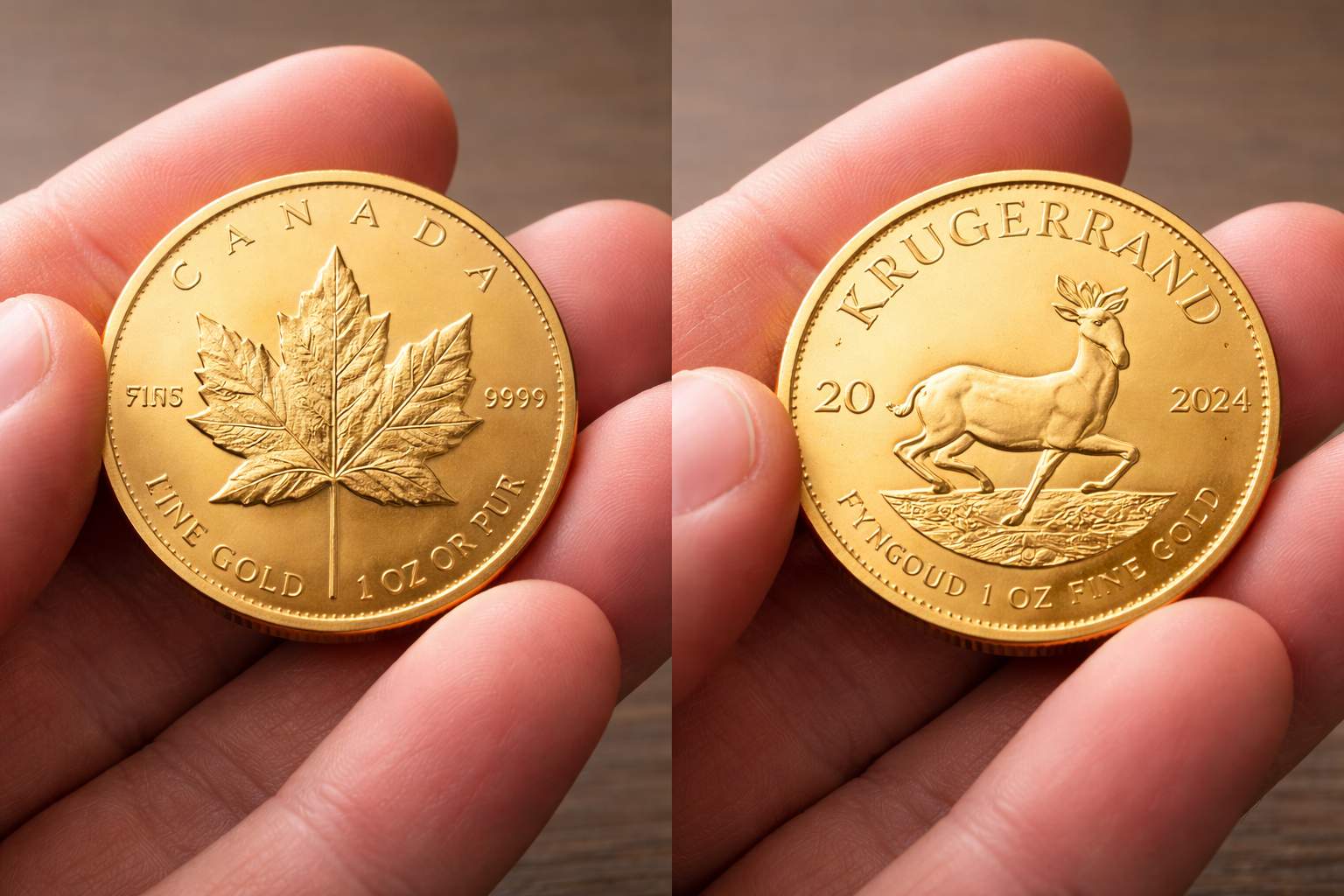
What Investment Coins Look Like
Popular investment coins include:
- Canadian Maple Leaf
- American Gold Eagle
- Vienna Philharmonic
- Krugerrand
These coins:
- Weigh exactly 1 oz (or fractional sizes)
- Have standardized designs
- Are recognized worldwide
- Can be resold quickly to dealers or private buyers
Why Coins Often Win
In practice:
- Coins are easier to sell in small amounts
- Dealers trust them instantly
- Counterfeit risk is lower
- Some jurisdictions treat coins more favorably for tax or resale
For most individual investors, coins are the most flexible form of physical gold.
Storage Reality: Where Investment Gold Actually Ends Up
Gold ownership doesn’t stop at purchase. Storage is where theory meets reality.
Common Storage Choices
-
Home storage
Small safe, hidden storage, no annual fees, higher theft risk -
Bank safe deposit box
Annual cost, limited access hours, no default insurance -
Professional vaulting
Used for larger holdings, full insurance, annual fee (0.3%–1%)
Gold stored at home is fully under your control — but not liquid during emergencies. Vaulted gold is safer but adds ongoing cost.
“Paper Gold”: What It Looks Like on a Screen
Not all investment gold is physical.
A gold ETF:
- Looks like a stock in your brokerage account
- Tracks the gold price closely
- Can be bought or sold instantly
- Has no storage hassle
However:
- You don’t hold physical gold
- Redemption into bullion is usually impossible for small investors
- You rely on fund structure and custodians
For many investors, ETFs are how gold actually exists day-to-day.
Digital Gold Platforms: Useful but Limited
Some platforms allow you to buy “digital gold” backed by physical bullion.
In practice:
- You buy fractions (0.1 g, 1 g)
- The gold is stored by a third party
- Selling is easy
- Taking delivery is expensive or impractical
This works well for price exposure, but less well for people who want direct possession.
How Gold Actually Behaves in a Portfolio
Gold rarely behaves like stocks or real estate — and that’s the point.
Real Portfolio Example
Imagine a simple portfolio:
- 60% stocks
- 30% bonds
- 10% gold
In market stress periods:
- Stocks may fall sharply
- Bonds may stabilize
- Gold often moves sideways or rises modestly
Gold’s role here is damage control, not growth.
If you want to see how gold would have behaved alongside other assets over time, tools like this gold ROI calculator can help visualize scenarios without overcomplicating things.
What Investment Gold Does Not Look Like
Investment gold is usually not:
- Actively traded daily
- Used for income generation
- Leveraged for high returns
- Optimized for short-term gains
Common Mistakes People Make With Investment Gold
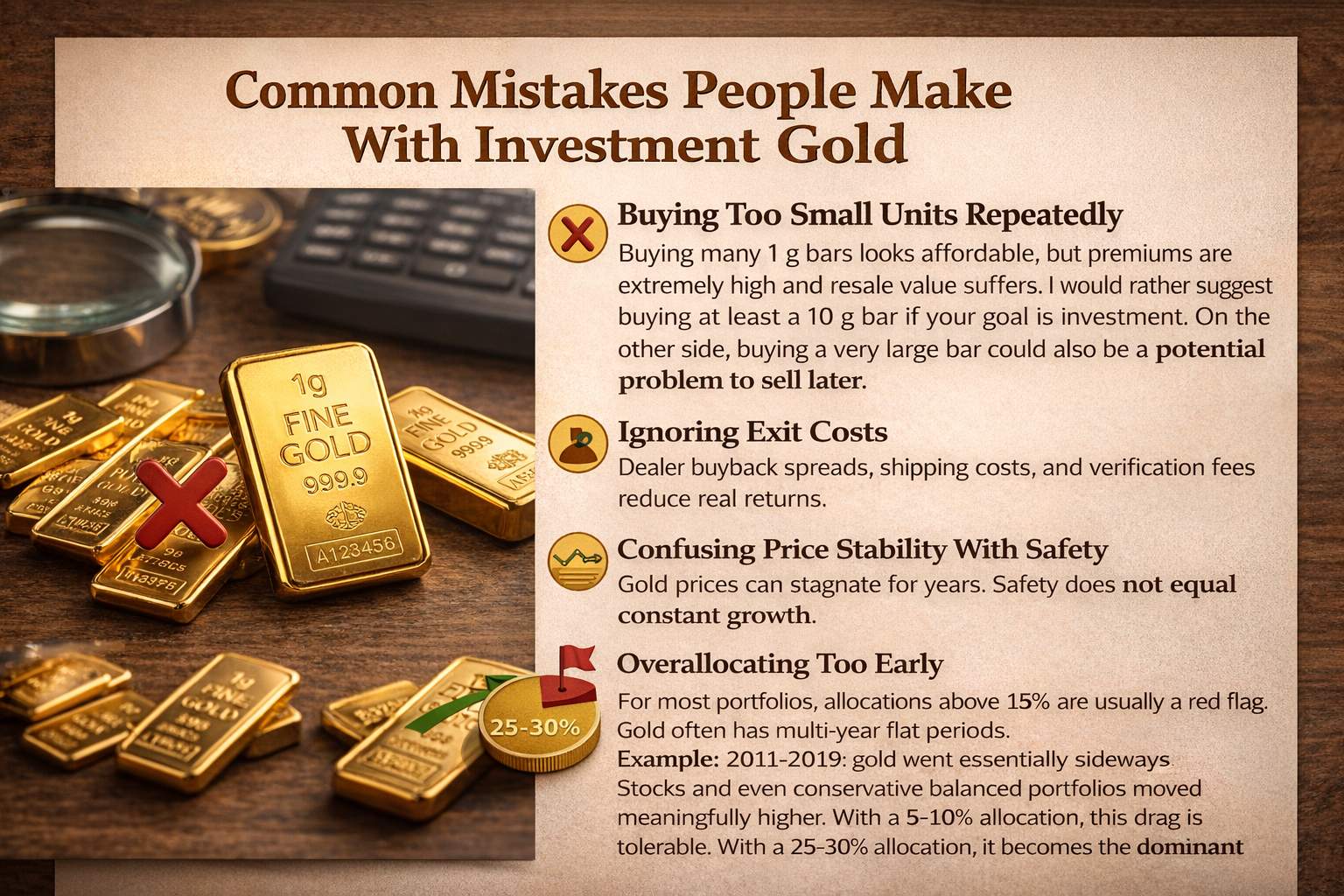
Buying Too Small Units Repeatedly
Buying many 1 g bars looks affordable, but premiums are extremely high and resale value suffers. I would rather suggest buying at least a 10 g bar if your goal is investment. On the other side, buying a very large bar could also be a potential problem to sell later.
Ignoring Exit Costs
Dealer buyback spreads, shipping costs, and verification fees reduce real returns.
Confusing Price Stability With Safety
Gold prices can stagnate for years. Safety does not equal constant growth.
Overallocating Too Early
For most portfolios, allocations above 15% are usually a red flag. Gold often has multi-year flat periods. Example: 2011–2019: gold went essentially sideways Stocks and even conservative balanced portfolios moved meaningfully higher With a 5–10% allocation, this drag is tolerable. With a 25–30% allocation, it becomes the dominant performance limiter. However, in 2025, gold rose more than 40%, so it was a profitable year to invest in gold.
Tax and Reporting Reality (Often Overlooked)
Depending on jurisdiction:
- Physical gold may be VAT-free or taxed
- Capital gains tax may apply on sale
- ETFs can be taxed differently than bullion
Always check local tax rules, not generic advice.
Final Thoughts
So what does investment gold actually look like?
It looks like:
- A small, heavy bar in a safe
- A widely recognized coin in a capsule
- A ticker symbol in a brokerage account
- A quiet line in a diversified portfolio
It does not look exciting most of the time — and that’s intentional.
Used correctly, gold is a stabilizer, not a performer. Understanding its physical forms, costs, and limits helps avoid disappointment and misuse.
Related:
- Gold or Silver: Which Is Better for Long-Term Investors?
- What Can Reduce the Resale Value of Investment Gold?
About the Author
I am a software developer focused on building financial modeling tools and investment simulations that help long-term investors understand compounding, market cycles, and portfolio behavior.
I created PortfolioCalc to explore how contribution timing, return sequences, and different asset classes impact long-term wealth outcomes. The calculators and examples on this site are based on quantitative modeling and scenario analysis.
In addition to developing these tools, I personally invest in diversified ETFs, gold, and Bitcoin using a long-term, data-driven approach. While I am not a licensed financial advisor, the content on this site is designed to translate financial mathematics into practical, educational insights.