Which Is Safer for Beginners: Investing in the S&P 500 or Nasdaq 100?
For beginner investors, the word safe is often misunderstood. It does not mean “no losses” or “guaranteed returns.” In practice, safety means something more specific and more practical: how likely you are to stay invested long enough for investing to actually work.
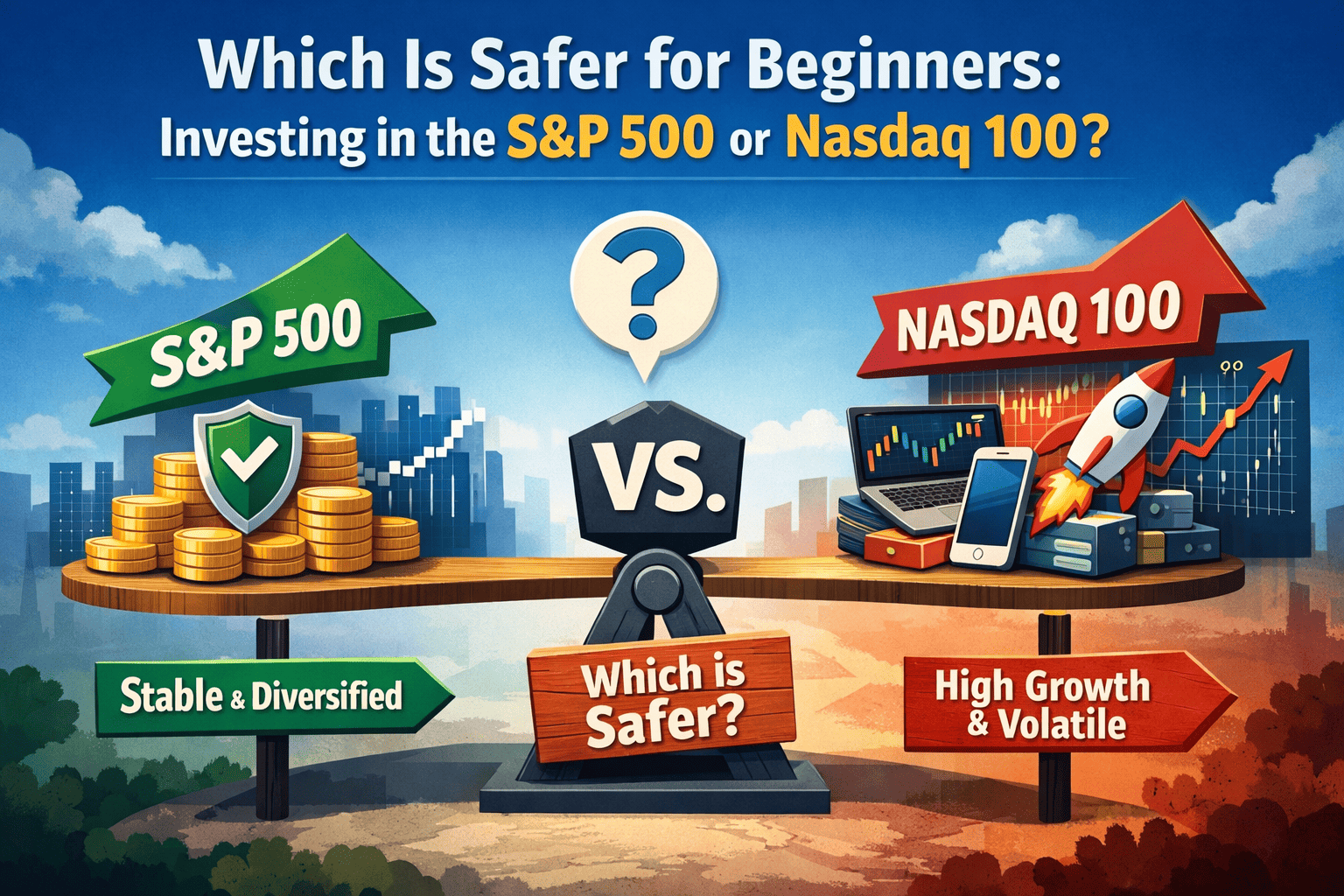
This article does not explain what the S&P 500 or Nasdaq 100 are. Plenty of guides already do that.
Instead, it focuses on one narrow question that matters early on:
Which index creates fewer situations where beginners make irreversible mistakes?
Before I continue, just a quick comparison. At the time of writing this article, the annual growth of the Nasdaq 100, looking historically, is about 14% on average. That is the period since 1985. In the same period, the growth of the S&P 500 was about 11.8% (historically since 1926 it is about 10%).
This is in favor of the fact that the Nasdaq 100 achieved higher annual growth and returns during the same period. Regardless, I must say that I personally currently only own S&P 500 shares, although I certainly do not rule out the possibility of buying Nasdaq 100 shares in the future.
What “Safe Investing” Really Means for Beginners
For someone in their first few years of investing, safety is mostly about behavior, not math.
A “safer” investment is one that:
- Produces fewer extreme drawdowns
- Recovers in a way that feels understandable
- Does not rely on a single sector staying dominant
- Reduces the temptation to sell during stress
The index with the highest long-term return is not automatically the safest if most beginners cannot hold it through bad periods.
This is significant for new investors because what is important is to remain consistent with investing even in times of stock market declines and when things are not looking good.
The First Real Test for Beginners: How S&P 500 and Nasdaq 100 Perform in Market Crashes
Most beginners start investing during relatively calm or rising markets. The real test comes when the first meaningful decline happens.
Example Scenario: Beginner Investing in S&P 500 vs Nasdaq 100
Two new investors start at the same time:
- Investor A invests $10,000 into the S&P 500
- Investor B invests $10,000 into the Nasdaq 100
Within the first two years, the market enters a sharp downturn.
What usually happens:
- The Nasdaq 100 drops faster and deeper
- The S&P 500 also falls, but typically by a smaller percentage
The difference between seeing:
- –18% and
- –35%
is not just a number. For beginners, it often determines whether they:
- Stay invested
- Stop contributions
- Sell entirely
From a safety perspective, the depth of the initial drawdown matters more than the eventual recovery.
I can say that I experienced that at one point the S&P 500 index dropped sharply, in a short period by 20%. The feeling was very bad, considering that I had just started investing, I wondered if it was a good decision. At that moment, the Nasdaq also fell by the same percentage, but it could easily have been much worse.
It is much easier to stay consistent and continue investing if these variations are smaller.
Why Drawdowns Matter More Than Returns for Beginner Investors
Experienced investors often say, “It always comes back.”
They say this because they have already experienced and overcome this situation several times and thereby strengthened their belief, even though it is never easy to see stocks drop sharply.
Beginners don’t experience markets that way.
Large drawdowns create three practical problems:
- Losses feel permanent
- Recovery timelines feel uncertain
- Confidence in the strategy collapses
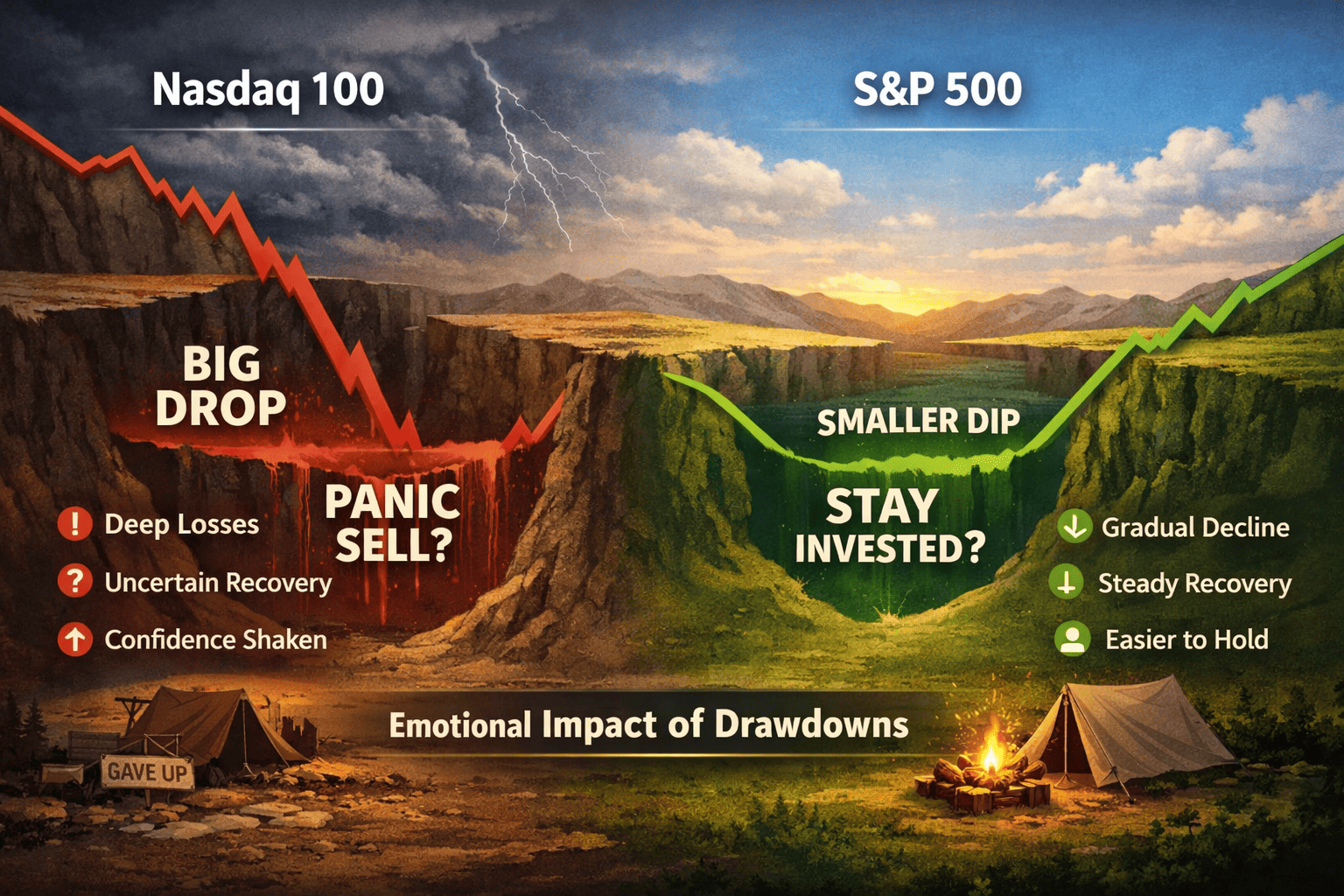
The Nasdaq 100 has historically experienced:
- Deeper drawdowns
- Faster declines
- Longer psychological recovery periods
The S&P 500, while not immune, usually:
- Declines more gradually
- Recovers in a more predictable pattern
- Feels easier to hold through stress
Safety insight:
A portfolio that you can hold through bad years is safer than one you abandon at the bottom.
Concentration Risk in Nasdaq 100 vs S&P 500 (Beginner Perspective)
One of the most overlooked safety risks for beginners is concentration, not volatility.
Over time, the Nasdaq 100 tends to become heavily concentrated in:
- A small number of large technology companies
- A single sector driving most returns
This creates a fragile situation for beginners:
- Portfolio results depend on one industry staying dominant
- Sector-specific downturns feel like total failure
- Losses feel harder to justify emotionally
The S&P 500 spreads exposure across many sectors. Even when technology underperforms, other areas often soften the impact.
From a beginner’s point of view:
- Broader exposure feels more intuitive
- Losses are easier to contextualize
- There is less pressure to “guess the future”
Safety insight:
Diversification reduces the chance that one wrong assumption ruins the experience.
Recovery Speed vs Recovery Experience: How Beginners Perceive Market Rebounds
It is true that the Nasdaq 100 often rebounds strongly after major crashes.
However, beginners don’t experience recoveries as clean charts.
Practical difference:
- Nasdaq recoveries can be sharp but uneven
- S&P 500 recoveries are usually slower but steadier
For a beginner who checks their account monthly:
- Uneven recoveries feel like repeated disappointment
- Steady recoveries feel like progress, even if slower
Safety is not just how fast an index recovers —
it is how it feels while recovering.
Early Contribution Risk: Why Timing Matters More for Beginner Investors
Beginners often invest consistently for the first few years while learning. Timing matters more early on than most realize.
If early contributions coincide with:
- A tech-heavy boom followed by a correction (Nasdaq risk)
- A broad market slowdown (S&P 500 risk)
The Nasdaq 100 can create a situation where:
- Several years of contributions sit underwater at once
- Motivation to continue drops sharply
The S&P 500, due to broader exposure, reduces the chance that all early contributions are hit by the same sector decline.
Safety insight:
Early discouragement has a bigger impact than later volatility.
Common Beginner Investing Mistakes and Why Nasdaq 100 Amplifies Them
The Nasdaq 100 does not cause mistakes — it magnifies them.
Common beginner errors include:
- Chasing recent performance
- Checking balances too frequently
- Reducing exposure after losses
- Abandoning strategy during drawdowns
Because Nasdaq movements are larger:
- Emotional reactions are stronger
- Mistakes happen faster
- Recovery from bad decisions takes longer
The S&P 500 does not eliminate these mistakes, but it reduces their intensity.
Why Most Beginner Investors Overestimate Their Risk Tolerance
Many beginners believe they have high risk tolerance — until they experience actual losses.
Risk tolerance is rarely known in advance. It is revealed during:
- Prolonged drawdowns
- Sideways markets
- Multi-year underperformance
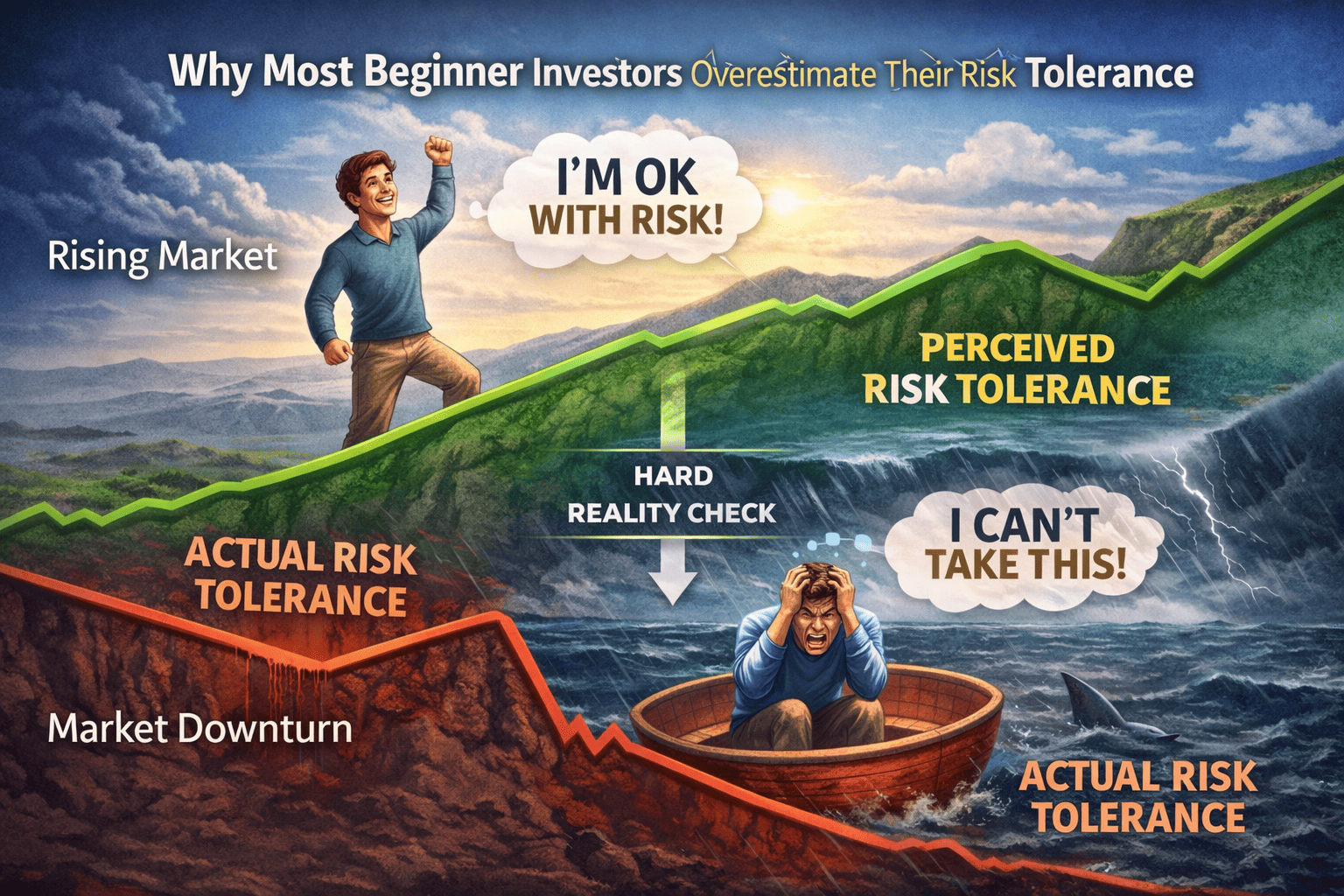
Nasdaq exposure tests risk tolerance quickly.
S&P 500 exposure tests it more gradually.
From a safety standpoint, gradual stress testing is better than sudden shocks.
Beginner Portfolio Allocation: Combining S&P 500 and Nasdaq 100
Instead of choosing one index exclusively, many beginners end up combining them — intentionally or not.
Examples:
- Employer retirement plans dominated by S&P 500 funds
- Personal brokerage accounts adding Nasdaq exposure later
A common beginner-friendly structure:
- Majority S&P 500
- Smaller Nasdaq allocation
This approach:
- Reduces overall volatility
- Maintains exposure to growth
- Avoids all-or-nothing decisions
If you want to explore how different allocations behave over time without committing money, a simple calculator can help visualize outcomes.
Used calmly, tools like this portfolio calculator can provide perspective without hype:
Explore S&P 500 Portfolio Calculator
The goal is not prediction — it’s understanding possible paths.
When Nasdaq 100 Can Make Sense for Beginner Investors
Nasdaq 100 is not “bad” or “wrong.”
It simply requires conditions that many beginners do not yet have.
It may be reasonable if:
- Investment horizon is very long (15–20+ years)
- Contributions are automated and consistent
- There is no need to touch the money
- Volatility does not affect decision-making
Without these conditions, volatility becomes a behavioral risk, not a theoretical one.
Is the S&P 500 or Nasdaq 100 Truly Safe? Understanding the Limits
It is important to be clear:
- Neither index is safe in the short term
- Both can experience multi-year losses
- Both depend on global economic forces
Safety here is relative, not absolute.
The comparison is about:
- Which index reduces the chance of quitting
- Which index creates fewer emotional traps
- Which index aligns better with beginner behavior
S&P 500 vs Nasdaq 100: Safety Comparison for Beginner Investors
| Aspect | S&P 500 | Nasdaq 100 |
|---|---|---|
| Typical drawdowns | Smaller | Larger |
| Sector concentration | Broad | High |
| Emotional pressure | Moderate | High |
| Recovery experience | Steadier | Uneven |
| Beginner mistake risk | Lower | Higher |
Final Verdict: Which Index Is Safer for Beginner Investors?
For beginners, investing success depends less on picking the best-performing index and more on avoiding decisions that permanently derail the process.
From a safety perspective:
- The S&P 500 is generally safer because it:
- Produces smaller drawdowns
- Spreads risk across the economy
- Is easier to stay invested in during stress
- The Nasdaq 100 is riskier because:
- Losses are deeper and faster
- Sector concentration increases fragility
- Emotional pressure is significantly higher
I have to repeat that everyone individually knows for themselves, but all that has been stated so far is my personal impression. No one can guarantee how different indexes will behave in the future and everything is based on historical data that may not always be accurate. It is a certain amount of risk that all of us who invest have to deal with and take into account.
For most beginners, starting with the S&P 500 — and adding Nasdaq exposure later if experience and tolerance allow — is the more practical and safer approach.
Early investing is not about being optimal.
It is about still being invested when compounding finally matters.