How Inflation Impacts Long-Term Portfolio Growth
Does the money we had 10 years ago have the same value as it does today?
Is our purchasing power the same with the same amount of money as it was back then?
And how much will today’s money actually be worth in 10 or 20 years?
These are questions many people rarely stop to think about, yet they are essential for understanding personal finance and investing. Inflation is a silent force that affects everyone, and I would describe it as the biggest enemy of every investor.
When we take a calculator and try to estimate how much money we will have from investing over the next X years, we usually focus on the final number — the total amount or total profit. What often gets overlooked, however, is inflation: how much that money will really be worth in terms of purchasing power.
Profit is typically the first thing that comes to mind when planning investments, because it helps us visualize what our portfolio might look like in the future. But without accounting for inflation, that picture can be misleading.
Why Inflation Matters for Long-Term Investors
Here’s a real-world example of how inflation quietly destroys purchasing power over time.
I have heard stories about people who saved large amounts of money and decided not to invest their money anywhere but to save it for later, for their children, etc. Specifically, I heard about a family who saved money with which they could have bought an apartment in a good location in the city 25 years ago. I think the figure was around $50,000.
Their money was worthless over time, and the average annual inflation in the country they lived in at that time was a high 11%. In the US, the average inflation was around 2.5% during this period, but I want to show you this extreme case for illustration.
With that money, the family could have easily bought a larger apartment in a good location in the city at that time. If you look at this calculator, you will notice that with an inflation rate of 11%, the real value of money after 25 years has dropped from $50,000 to $3,680, which is 13.5 times smaller.
Check out the calculation on this calculator
This is a typical example of disaster and lost money. People who don't know what inflation is don't even realize how much damage they can cause themselves when money sits idle in the long run.
When I started investing, I calculated that I could have started about 4–5 years earlier. Considering that during that period the annual inflation rate in my country was about 7%, I calculated that I lost more than $10,000 just from sitting idle.
If I had invested that same money in an asset that generates 10% annual income (for example, the S&P 500), I would be in the plus of about $24,000 instead of in the minus of $10,000. That’s a huge difference.
This is a mistake I personally made early in my investing journey, and it cost me years of lost purchasing power.
A Simple Example of Inflation and Purchasing Power (100 Dollars vs Cheeseburgers)
.png)
Let’s look at a simple example to illustrate this.
Imagine it is 2015 and you have 100 dollars. At that time, let’s say the average price of a cheeseburger was around 4 dollars. With 100 dollars, you could buy 25 cheeseburgers.
Now fast forward 10 years.
If we take into account that the average annual inflation rate in the United States over the past decade has been around 3%, the real value of those same 100 dollars has declined. In today’s terms, that money is worth approximately 74.41 dollars.
In other words, even though the number on the bill hasn’t changed, its purchasing power has. With 74 dollars today, you can buy roughly 18 cheeseburgers instead of 25. That represents a 26% loss in purchasing power.
This is a critical number to understand if you want a realistic picture of what your money will be worth in the future. Too often, when calculating potential investment returns, this factor is ignored entirely.
Why Inflation Matters in Real Life
So why is this important?
Let’s imagine you want to buy a house that currently costs 300,000 dollars. You have no savings at the moment, meaning you need the full 300,000 dollars to reach your goal. Suppose you are able to save around 5,000 dollars per month, or 60,000 dollars per year.
At first glance, the math seems straightforward:
- 300,000 dollars ÷ 60,000 dollars per year = 5 years of saving
After five years of disciplined saving, you reach your target of 300,000 dollars. But here’s the problem.
If we assume an average inflation rate of 3% per year — and that the prices of goods, services, and real estate increase at roughly the same pace — that same house will no longer cost 300,000 dollars after five years. Instead, its price will be close to 348,000 dollars.
Now you’re short an additional 48,000 dollars.
That means you need roughly another 9 to 10 months of saving. But during that additional time, prices continue to rise due to inflation. As a result, you only reach the required amount at the end of the sixth year — not the fifth.
You can use this calculator to verify this with inflation rate 3%.
The Reality Is Often Harsher
This example assumes ideal conditions:
- Stable income
- Consistent savings
- Moderate inflation
- No unexpected expenses
In reality, things are rarely that simple.
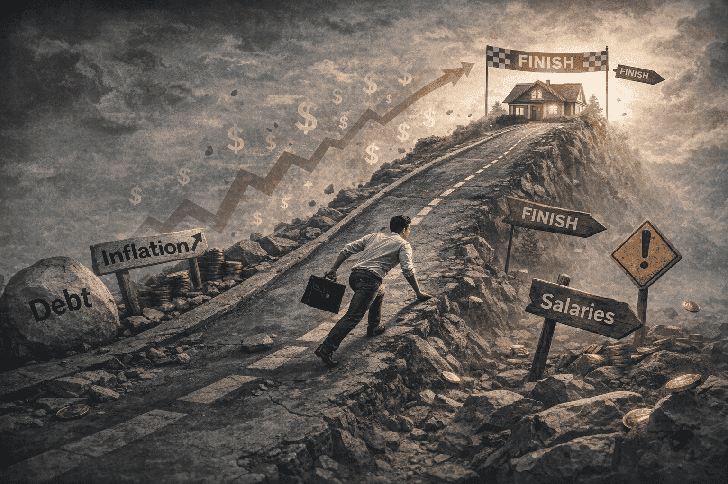
Inflation can be higher than average. Salaries often fail to keep pace with rising prices. Unexpected costs are almost inevitable. In poorer countries or developing economies, inflation can be significantly higher, making long-term planning even more difficult.
Because of this, many people misjudge when they will actually be financially capable of buying a home. Instead of reaching their goal, they find themselves in a prolonged chase where the finish line keeps moving further away.
Nominal vs. Real Value of Money
This is why it is so important to understand the difference between nominal and real value.
- Nominal value is the number you see on your bank account.
- Real value is what that money can actually buy after inflation is taken into account.
Focusing only on nominal figures can give a false sense of progress. What truly matters is whether your money is maintaining or increasing its purchasing power over time.
Final Thoughts
Inflation is a quiet but relentless force. It doesn’t make headlines every day, but over long periods, it can dramatically reduce the value of your money.
Understanding inflation is one of the most important steps toward financial literacy. Without it, long-term planning becomes flawed, expectations become unrealistic, and financial goals are harder to achieve.
When you calculate how much your portfolio might be worth in the future, don’t just look at the final number. Ask yourself a more important question:
What will that money actually be able to buy?
Before setting any long-term financial goal, try calculating its real, inflation-adjusted value. It might change your entire plan.