Most investors hope the bull market comes early, but mathematically, that might be the worst possible outcome.
Bull market first 10 years vs last 10 years
Bull market - is a long period of asset price growth, in other words, it implies economic growth.
Bear market - the opposite of a bull market, i.e. a period of crisis, a period of economic stagnation or decline in asset value.

Let’s break this down using a practical 20-year example.
Bull market first 10 years vs last 10 years investing example
I want to show you through this practical example how investing during stagnation period can result in better profit later.
We will take two cases of investing in assets for 20 years, namely 300 dollars per month with an annual growth of 20% on average during the bull period and 0% growth during the bear period.
In the first case, let there be a bull market in the first 10 years and then stagnation for 10 years.
In the second case, let there be stagnation for the first 10 years and then growth for the next 10 years, i.e. bull period.
In what period do you think your investments will be worth more after 20 years? In the first or second case?
Through this article I will try to answer this question through this practical simulation.
1. Case - Bull period during the first 10 years
Average annual growth of 20% and a monthly investment of $300 with a starting investment of 0.
Investment Growth Calculator - bull period first 10 years
Check out the growth in the first ten years:
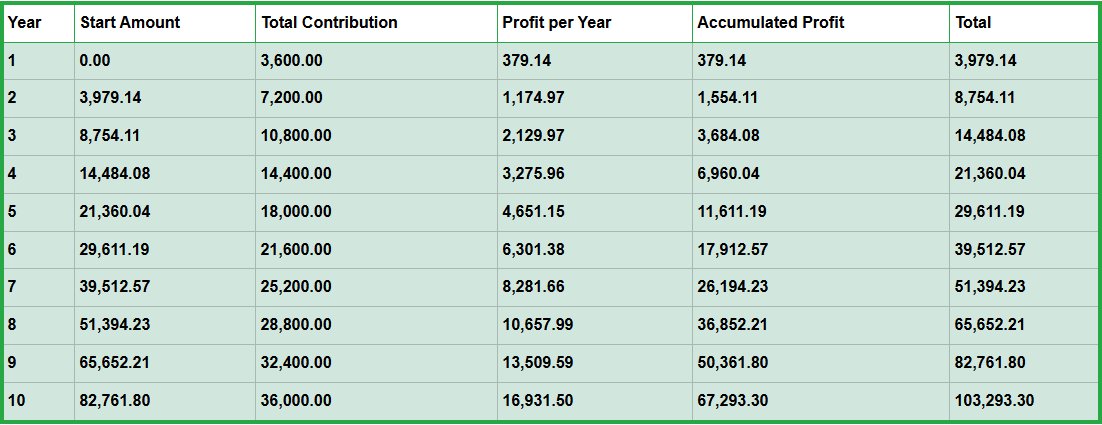
The investor will invest in the first 10 years a total figure of 36,000 dollars and will end the period of 10 years with a total figure of 103,293.30 (profit - 67,293.30).
In the last 10 years, the growth will be equal to zero, as an example of the lost decade, and the investor will invest an additional 36,000 dollars so that he will end the period with 139,293.30 and the total profit from the bull period - 67,293.30.
2. Case - Bull period during the last 10 years
Now let's look at what happens if we reverse this case and have stagnation for the first 10 years and growth for the last 10 years under the same investment conditions of $300 per month and a return of 0% in the first 10 years and 20% in the last 10 years.
In the first 10 years, the user will invest 36,000 and will not have a profit:
Investment Growth Calculator - bear period first 10 years
Then see what it looks like for the last 10 years if our starting sum for it is 36,000 and we still continue to bring in 300 dollars a month with an annual growth of 20%:
Investment Growth Calculator - bull period last 10 years
Look at the growth in last ten years of investment:
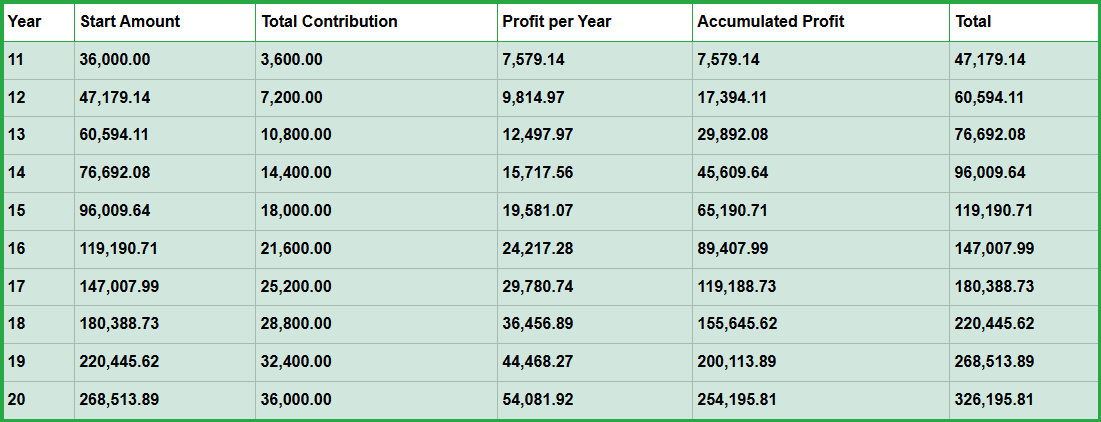
So the investor ends 20 years of investment with a total sum of 326,195.81 with the same investment of 72,000 dollars so that at the end he has a profit of 254,195.81.
If we compare 254,195.81 with the profit from the first example 67,293.30 the difference seems startlingly large. That is why long-term and patient investing often pays off in the end, although no one can know when a bear or bull period will occur.
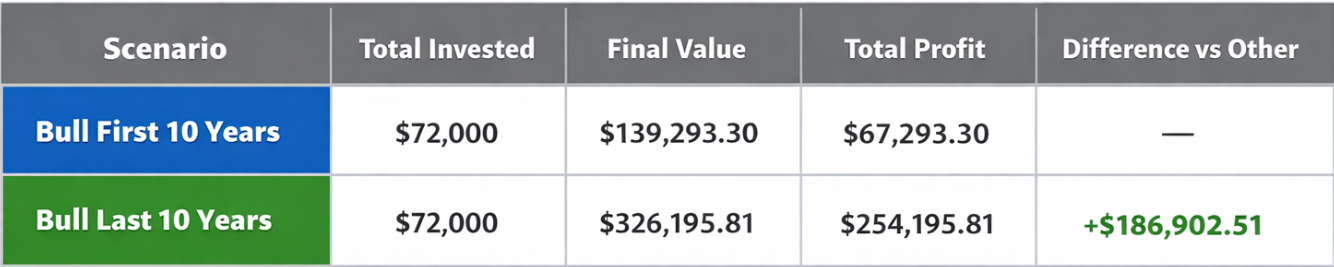
That is almost 4x more profit simply because the bull market happened later.
Same contributions.
Same returns.
Different timing.
Investing During a Bear Market
Many investors hesitate when markets decline. Yet historically, investing during a bear market has often produced strong long-term results for disciplined investors.
Lower asset prices allow consistent monthly contributions to accumulate more shares. While portfolio values may appear stagnant or disappointing in the short term, bear markets frequently lay the foundation for powerful future compounding.
In the second scenario of this article, the first 10 years appear “wasted.” But in reality, those years are accumulation years — building a larger capital base that later benefits exponentially when growth resumes.
Why Late Bull Markets Create More Wealth?
The answer lies in compound growth mechanics.
Compounding is often described as “interest on interest,” but that definition understates its true force. In reality, compounding is a multiplier that becomes dramatically stronger as the base it acts upon grows.
Compounding becomes exponentially more powerful when:
- You have accumulated a larger capital base.
- The strongest growth phase happens later in the investment cycle.
- Your consistent contributions during stagnant periods allow you to accumulate more units at lower prices.
Let’s unpack this carefully.

1. A Larger Capital Base Changes Everything
Returns are always applied as a percentage of your current portfolio value.
10% on $10,000 produces $1,000.
10% on $100,000 produces $10,000.
10% on $300,000 produces $30,000.
The percentage is the same.
The outcome is radically different.
In the early years of investing, even strong returns generate modest absolute gains because your capital base is small. But after years of steady contributions, the base becomes substantial. When strong growth finally arrives, the same percentage return now produces dramatically larger dollar gains.
This is the mathematical core of why late bull markets can be more powerful.
2. Growth Applied to Accumulated Capital Creates Acceleration
When the bull market arrives after a long accumulation phase:
- You own more shares.
- You have invested more total capital.
- You have built a larger platform for growth.
Now returns are not just growing your contributions — they are growing years of accumulated contributions.
This creates acceleration.
In earlier phases, growth is incremental.
In later phases, growth becomes multiplicative.
It is the difference between lighting a match and fueling a wildfire.
3. Stagnation Years Are Accumulation Years
During flat or stagnant markets, something counterintuitive happens:
- You are quietly accumulating more ownership.
- Because prices are not rising significantly, your monthly contributions buy more shares at lower average prices.
- There is no visible reward in the portfolio balance, but there is invisible structural improvement happening underneath — your ownership stake increases.
When growth finally resumes:
- Every one of those accumulated shares participates.
- Every contribution made during “boring” years compounds simultaneously.
- The market multiplies a much larger ownership base.
Stagnation is not wasted time.
It is preparation time.
In my case, I took a drastic example of 20% growth, but with the S&P 500 index, a bull period often happened in decades, even in 60-70% of cases, only the growth was not 20%. One in 3 decades yield at least 15%.
The S&P 500 experienced something similar:
2000–2009 → almost flat decade
2010–2019 → one of the strongest bull markets in history
Investors who kept investing during the stagnant period were rewarded disproportionately in the following decade.
Final Verdict
We all want a bull period in the last 10 years of our investment and not in the first 10 because our returns are growing, i.e. the effect of compound interest becomes stronger when we have a larger amount at our disposal.
The conclusion is that patience in the long run can pay off many times over, even if we don't have any profit for the first 10 years of investing. This is psychologically difficult for many to continue entering even in such a long period without returns.
The market does not reward early excitement.
It rewards endurance.
The investor who survives the stagnation decade is often the one who benefits from the explosive decade.
Frequently Asked Questions About bull vs bear market investing
Is it better to buy in a bull or bear market?
For long-term investors who invest consistently, buying during bear or stagnant markets can be advantageous because it allows accumulation at lower prices. When a bull market eventually begins, returns compound on a larger capital base.
Should I stop investing during a bear market?
Historically, continuing to invest during bear markets has rewarded disciplined investors. Bear markets allow investors to accumulate more shares at lower prices, which can significantly increase long-term returns once the market recovers.
Does dollar-cost averaging work better in bear markets?
Dollar-cost averaging can be especially effective during bear markets because fixed contributions purchase more shares when prices are lower. Over time, this can reduce average cost per share and enhance compounding effects.
Should I wait for a bull market before investing?
Waiting for a bull market may mean missing early recovery gains. Since market timing is extremely difficult, consistent investing regardless of market phase has historically produced better long-term outcomes.